|
The Western world has met the oud during the Crusades and has taken the oud along with them to Europe. The name of this instrument is Luth in French, Lute in English, Laute in German, Liuto in Italian, Luit in Dutch, (all beginning with the letter L) and Alaud in Spanish. The word luthier meaning instrument maker is also derived form the word luth.
According to Farabi, the oud was invented by Lamech, the sixth grandson of Adam. The legend tells that the grieving Lamech hung the body of his dead son from a tree. The first oud was inspired by the shape of his son's bleached skeleton. The oldest pictorial record of a lute dates back to the Uruk period in Southern Mesopotamia, over 5000 years ago on a cylinder seal acquired by Dr. Dominique Collon and currently housed at the British Museum. The image depicts a female crouching with her instruments upon a boat, playing right-handed. This instrument appears many times throughout Mesopotamian history and again in ancient Egypt from the 18th dynasty onwards in long and short-neck varieties. One may see such examples at the Metropolitan Museums of New York, Philadelphia, Cleveland, and the British Museum on clay tablets and papyrus paper. This instrument and its close relatives have been a part of the music of each of the ancient civilizations that have existed in the Mediterranean and Gulf regions, including the Sumerians, Akkadians, Persians, Babylonians, Assyrians, Greeks, Egyptians, and Romans. According to Master Behruzinia, Iran's leading barbat player, the barbat is the predecessor of the oud. The barbat was modified by Arabs and was henceforth called oud. The ancient Turkic peoples had a similar instrument called the Kopuz. This instrument was thought to have magical powers and was brought to wars and used in military bands. This is noted in the Göktürk monument inscriptions, the military band was later used by other Turkic state's armies and later by Europeans.[1] Turkish oud is very different than arabic oud in playing style and shape. In Greece and Armenia musicians especially use the Turkish ouds and tunings.
Defining features
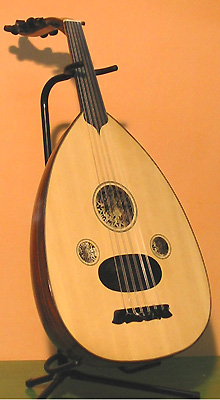
Lack of Frets: The oud, unlike many other plucked stringed instruments, does not have a fretted neck. This allows the player to be more expressive by using slides and vibrato. It also makes it possible to play the microtones of the Maqam System. This development is relatively recent, as ouds still had frets ca. AD 1100, and they gradually lost them by AD 1300, mirroring the general development of Near-Eastern music which abandoned harmony in favor of melismatics.
Strings: With some exceptions, the oud has eleven strings. Ten of these strings are paired together in courses of two. The eleventh, lowest string remains single. There are many different tuning systems for the oud which are outlined below. The strings are generally lighter to play than the modern classical guitar.
Pegbox: The pegbox of the oud is bent back at a 45-90° angle from the neck of the instrument.
Body: The oud's body has a staved, bowl-like back resembling the outside of half a watermelon, unlike the flat back of a guitar. This bowl allows the oud to resonate and have a more complex tone.
Sound-holes: The oud generally has one to three sound-holes.
Regional types
The following are the general regional characteristics of oud types in which both the shape and the tuning most commonly differ:
Arabic ouds:
Syrian ouds: Slightly larger, slightly longer neck, lower in pitch.
Iraqi (Munir Bechr type) ouds: Generally similar in size to the Syrian oud but with a floating bridge which focuses the mid-range frequencies and gives the instrument a more guitar-like sound. This kind of oud was developed by the Iraqi oud virtuoso Munir Bechir.
Egyptian ouds: Similar to Syrian and Iraqi ouds but with a more pear shaped body. Slightly different tone. Egyptians commonly string only the lower courses up to 'g'. Egyptian Ouds tend to be very ornate and highly decorated.
Turkish style ouds ("ud") (Includes instruments found in Armenia and Greece): Slightly smaller in size, slightly shorter neck, higher in pitch, brighter timbre. It's known as outi in Greece and was used by early Greek musicians.
Barbat (Persian Oud): smaller than Arabic ouds with different tuning and higher tone. Similar to Turkish ouds but slightly smaller.
Oud Qadim: an archaic type of oud from North Africa, now out of use.
Although the Greek instruments Laouto and Lavta appear to look much like an oud, they are very different in playing style and origin, deriving from Byzantine lutes. The laouto is mainly a chordal instrument, with occasional melodic use in Cretan music. Both are always fretted (unlike the oud).
Plectrum (pick)
The plectrum (pick) for the oud is usually a little more than the length of an index-finger. Arabic players refer to it as a reeshe or risha, while Turkish players refer to it as a m&Mac245;zrap. Traditionally it is made from an eagle's feather or tortoise shell, however, plastic picks are much more commonly found today, and are considered just as effective and much cheaper. Oud players take the quality of their plectrums very seriously, often making their own out of other plastic objects, and taking great care to sand down any sharp edges in order to achieve the best sound possible.
Oud tunings
There are many different tuning options for the oud. All tunings are presented from the lowest course/single string to the highest course. The following tunings are from Lark in the Morning and Oud Cafe:
Arabic oud tunings
G A D G C F, This is the most commonly used tuning.
D G A D G C
C F A D G C
C E A D G C
F A D G C F
Turkish oud ("ud") tunings
Old Turkish Classical Tuning: A D E A D G
New Turkish Classical Tuning: F# B E A D G
Turkish\Armenian Style Tuning: E A B E A D
Turkish\Armenian Style Tuning Variant: C# F# B E A D
Standard Cümbü? Tuning: D E A D G C
List of famous oud players
In Iran:
Hossein Behroozinia (1962-)
Arsalan Kamkar (1960-)
Mansour Nariman (1938-)
Mohammad Delnavazi (1954-)
Mohammad Firoozi (1957-)
Jamal Jahanshad (1948-)
Yousef Kamoosi (1902-1987)
Mohammad Khansarian (1948-)
Hasan Manoochehri (1934-)
Shahram Mirjalali (1959-)
Akbar Mohseni (1911-1995)
Abdulvahab Shahidi (1921-)
Nasrollah Zarrinpanjeh (1906-1982)
In United States, of Armenian descent:
John Berberian
Richard Hagopian
John Bilezikjian
Charles "Chick" Ganimian
George Mgrdichian
Marko Melkon (Melkon Alemsharian)
Harry Minassian
In Turkey:
Udi Hrant Kenkulian (of Armenian descent)
Co?kun Sabah
Çinuçen Tanr&Mac245;korur
Serif Muhiddin Targan
Yorgo Bacanos (of Greek descent)
Necati Çelik
Yurdal Tokcan
Mutlu Torun
In Iraq:
Rahim Al Haj
Jamil Bashir
Munir Bashir (Iraq/Hungary)
Ahmed Mukhtar
Naseer Shamma
In Morocco:
Said Chraybi
Ahmed El Bidaoui
Driss El Maloumi
Armand Sabach
In Lebanon:
Rabih Abou-Khalil
Marcel Khalife
Charbel Rouhana
In Palestine:
Samir Joubran
Simon Shaheen
Samer Totah [2]
In Syria:
Farid Al Attrach (Syria/Egypt)
Alsiadi [3] (Syria/USA)
Ziad Rajab [4] (Syria/Greece)
In Tunisia:
Anouar Brahem
Amine-Hamza M'RAIHI
Ali Es-Sriti
Khmaies Tarnen
In Israel:
Yair Dalal (Israel/Iraq)
Taiseer Alias
Armond Sabah (Israel/Morocco)
Others:
Gordon Grdina (Canada)
Hamza El Din (Egypt)
Alekos K. Vretos [5] (Greece)
Haig Yazdjian (Greece, of Armenian descent)
Ahmad Firdaus Baragbah (Jambi/Indonesia)
Zulkarnain Yusof (Johor/Malaysia)
Samir Zaki (Jordan)
Abadi Al Johar (Saudi Arabia)
Ali Bin Rogha (United Arab Emirates)
Ahmed Abdul-Malik (United States/Sudan)
Sandy Bull (United States)
Ahmed Fathi (Yemen)
List of famous oud makers
Manol (Manolis Venios)(Greek, living in Constantinople - 19th cen.)
Jafar Abedini (Iran)
Nariman Abnoosi (Iran)
Mohsen Ajdari (Iran)
Mohammad Taghi Arafti(Iran)
Mohammad Ashari (Iran)
Al Assel - Maurice Shehata (Egypt)
Mohammed Fadehl (Iraq)
Yaroub Fadhel (Iraq, making ouds in Tunisia)
Gawraret El Fan (Egypt)
Nazih Ghadban (Lebanon)
Hasan Manoochehri (Iran)
Fawzi Manshad (Iraq-Basra)
Ebrahim Ghanbari Mehr (Iran)
Mohammadi Brothers (Iran)
Khalil Mousavi (Iran)
Ebrahim Suker (Syria)
Bahram Taherian (Iran)
Faruk Turunz (Turkey)
Nahat & Sons (Syria)
Mario Epstein (Idaho)
Onnik Karibyan (Turkey, of Armenian descent)
External links
Alsiadi's Music Scores Alsiadi's Music Scores It's your one-stop source for classical Arabic & Middle Eastern Music
Oud Etudes Learning the Oud, a beginner's book in English
Al-Oud/The Oud a website by Dr David Parfitt
Maqam World a website by Johnny Farraj, Najib Shaheen, Sami Abu Shumays and Tareq Abboushi
The Ud (Oud), its players and recordings
Iranian Oud a website by Majid Yahyanejad
Mike's Ouds, includes Oud Forums
Brian Prunka Oud page
Oud Cafe, a website dedicated to Oud music
Play Oud by ear, a website dedicated to Oud teaching (study guide and audio cd)
From Wikipedia, the free encyclopedia
|